The Hidden Costs of “$20/month” AI Assistants
The sticker price for most AI assistants is $20/month. But $20/month is rarely the actual cost. The real number lives in the margins.
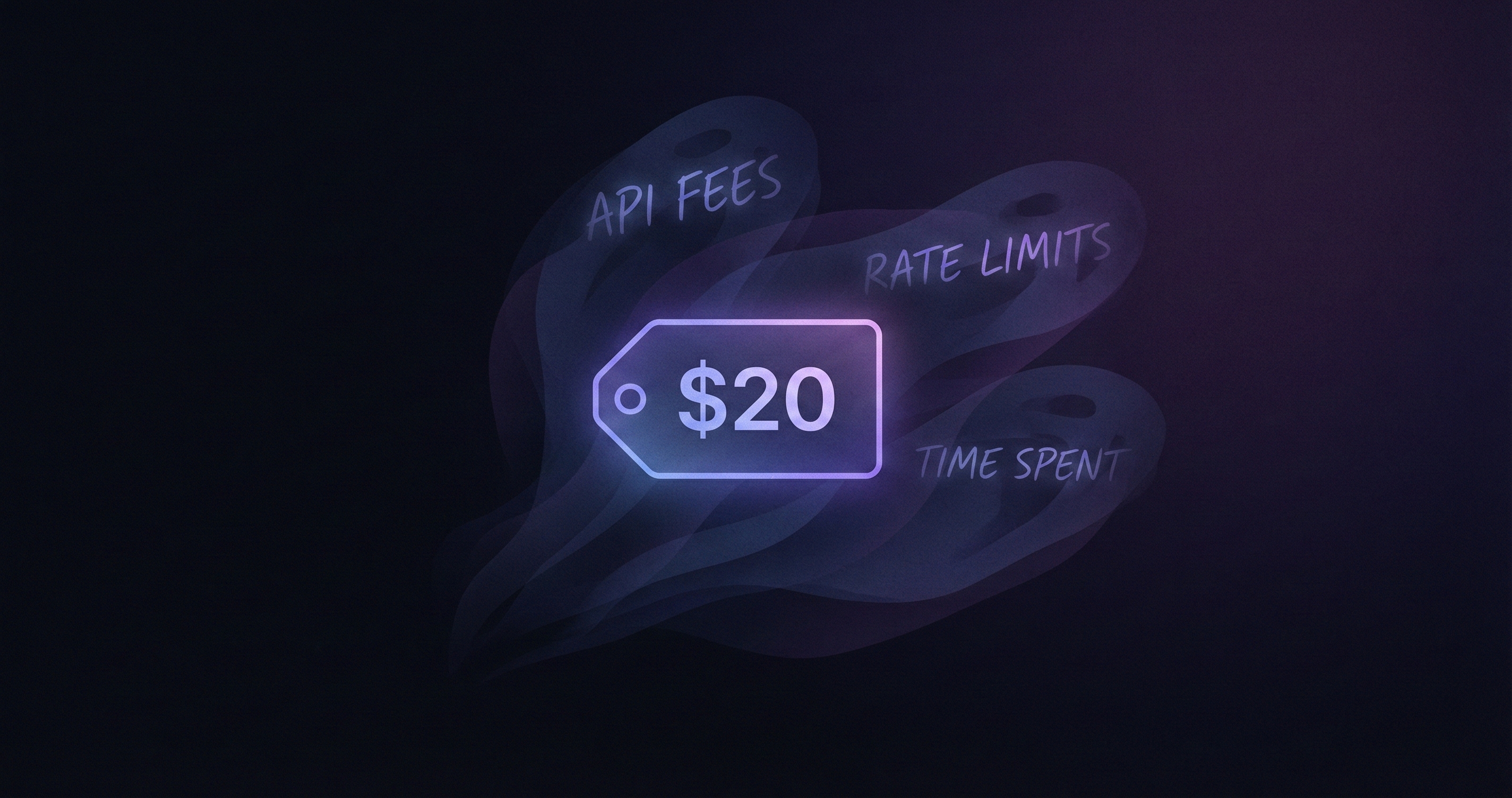
The sticker price for most AI assistants is $20/month. Claude Pro. Cursor Pro. ChatGPT Plus. Gemini Advanced.
Twenty dollars is the number everyone anchors on. It's low enough to feel casual—a Netflix subscription, more or less.
But $20/month is rarely the actual cost. The real number lives in the margins, in the limits, in the things that aren't included.
What $20 Actually Gets You
Let's be specific about what these subscriptions include:
Claude Pro — $20/month
- Higher usage limits than free tier
- Priority access during high-traffic periods
- Access to Claude 3.5 Sonnet
- Usage caps that reset every 5 hours, with hard limits possible during peak times
Cursor Pro — $20/month
- 500 "fast" requests per month
- Unlimited "slow" requests
- Access to GPT-4 and Claude models
- Overages charged per request beyond the limit
ChatGPT Plus — $20/month
- GPT-4 access with usage limits
- Image generation (DALL-E)
- Web browsing capability
- Usage caps that vary and aren't publicly documented in detail
Notice what's consistent: every $20 tier comes with limits. Hit the ceiling, and either your access degrades (slower responses, reduced capability) or you pay more.
The First Hidden Cost: Overages
Subscription pricing works when usage is predictable. AI assistant usage often isn't.
Some days you're in flow, asking question after question, iterating rapidly. Other days you barely touch it. The subscription model charges the same either way—but caps your high-usage days.
The math gets awkward:
- Light usage: You're paying $20 for capacity you don't use
- Heavy usage: You're hitting limits and either waiting or paying overages
Cursor's pricing page is transparent about this: 500 fast requests per month, then you're in slow mode or paying extra. For active developers, 500 requests can evaporate in a week.
The result is a subscription that's both too expensive (for light users) and insufficient (for heavy users). The $20 price point optimizes for neither—it just feels reasonable.
The Second Hidden Cost: API Keys Required
Here's where it gets strange.
Some tools charge a subscription and still require you to bring your own API key for certain features.
GitHub Copilot Business at $19/user/month includes LLM access. But tools that integrate with multiple models often require your own credentials for each provider.
This creates a layered cost structure:
- Subscription fee (for the tool)
- API costs (for the models)
- Management overhead (for maintaining multiple accounts)
You're paying for access, then paying again for usage, then spending time managing the infrastructure that connects them.
This overhead is more visible when you're running something like OpenClaw, where the BYOK burden is a known friction point. We've written about what changes when someone else handles credentials entirely—eliminating this layer of cost and complexity.
The Third Hidden Cost: Account Proliferation
The AI tool landscape is fragmented. You probably use multiple services:
- A coding assistant (Cursor, GitHub Copilot)
- A general assistant (Claude, ChatGPT)
- Specialized tools (writing assistants, image generators, etc.)
Each one wants:
- An account
- A payment method
- A subscription decision (free vs. paid)
- API credentials (sometimes)
Managing five $20 subscriptions is $100/month—and you're still context-switching between interfaces, managing separate billing, and tracking what capability lives where.
The cost isn't just money. It's cognitive load and administrative friction.
The Fourth Hidden Cost: Idle Capacity
Subscriptions run whether you use them or not.
Took a vacation? Still paying. Shifted to a different project that doesn't need the tool? Still paying. Forgot you subscribed? Definitely still paying.
The SaaS pricing guide from SaaSPricePulse notes that most developers use AI assistants intermittently—bursts of heavy usage followed by quiet periods. Flat subscriptions charge continuously for intermittent value.
The services know this. Monthly subscriptions with annual discounts are designed to lock in payments regardless of actual usage patterns.
What Usage-Based Pricing Looks Like
The alternative is paying for what you consume, not what you might consume.
API-direct usage (like Anthropic's API or OpenAI's API) follows this model:
- Pay per token (input and output)
- No monthly minimums
- Cost scales with actual usage
The downside: you need to manage API keys, monitor spending, and build or use tooling that connects to the API.
Platforms like ATXP bridge this gap—pay-per-use access through a unified gateway, without managing credentials for each provider. Your agent accesses Claude, GPT-4, Gemini, and Llama through one endpoint. You pay for tokens used, nothing more.
The Real Comparison
Let's run the numbers for a hypothetical developer:
Subscription Model (Cursor Pro + Claude Pro)
| Component | Monthly |
|---|---|
| Cursor Pro | $20 |
| Claude Pro | $20 |
| Overage buffer | $10-30 |
| Total | $50-70 |
Plus: subscription continues during low-usage periods.
Usage-Based Model (API access through ATXP)
| Component | Monthly (moderate use) |
|---|---|
| LLM tokens | $30-50 |
| Tool usage | $5-10 |
| Total | $35-60 |
Plus: scales to zero during low-usage periods.
The ranges overlap—heavy users might pay similarly either way. But:
- Usage-based aligns cost with value delivered
- No caps or degraded service during high-usage periods
- Zero cost during inactive periods
- One billing relationship instead of multiple subscriptions
When Subscriptions Make Sense
Subscriptions aren't always wrong. They make sense when:
- Your usage is consistent and predictable
- The subscription includes everything you need (no API keys required)
- You value price certainty over cost optimization
- The single tool covers most of your needs
For someone who uses Claude moderately every day, $20/month with no thinking required might be worth the simplicity.
When Pay-Per-Use Makes Sense
Usage-based pricing makes sense when:
- Your usage varies significantly week to week
- You use multiple AI capabilities (text, image, search, code execution)
- You'd rather not manage API keys across multiple providers
- You want costs that match actual value received
For someone building with AI—where usage is spiky and requirements span multiple modalities—pay-per-use is usually cheaper and more flexible.
The Price That Matters
$20/month is a number that fits on a pricing page. It's easy to compare, easy to budget, easy to approve.
But the useful question isn't "what's the sticker price?" It's "what will I actually pay, given how I actually work?"
That calculation includes overage fees, idle capacity, API costs, and the overhead of managing multiple subscriptions and credentials. It includes your time, not just your money. If you want to see the math for your own usage pattern, the AI Cost Calculator lets you compare subscriptions against pay-as-you-go side by side.
The cheapest option is the one that aligns cost with value—and for most AI usage patterns, flat subscriptions align poorly.
Curious about usage-based AI infrastructure? ATXP provides unified LLM access and tools—pay for what you use, nothing more.
Further Reading:
- The Real Cost of Running OpenClaw — A three-layer breakdown of hosting, API, and time costs
- OpenClaw Hosting Compared — Every hosting tier including pay-as-you-go options
- AI Coding Assistant Pricing in 2026 — SaaS Price Pulse's comparison
- Claude Pricing Explained — IntuitionLabs breakdown
- Best AI Coding Assistants 2026 — Shakudo's feature comparison
- Anthropic API Pricing — Direct API costs for Claude models
- AI Cost Calculator — Compare subscription vs. pay-as-you-go for your usage
- What Does Running OpenClaw Actually Cost? — ATXP's cost analysis